Beginner’s Guide to Choosing a Gaming Platform helps a reader pick console, PC, cloud, or handheld with less guesswork. It opens with one clear fact: the best platform matches goals, playstyle, and realistic budget. This guide shows how to decide in 2026 using current costs, concrete tradeoffs, and a short checklist. It avoids vague slogans and gives specific numbers, for example typical console hardware sits around $400–700, while an entry to mid-range gaming PC often runs $800–1,500. The next sections break choices into clear, action-ready steps.
Key Takeaways
- Choosing the right gaming platform in 2026 hinges on matching your goals, playstyle, and budget to avoid unnecessary spending.
- Consoles offer easy setup and reliable performance for casual and couch multiplayer, typically costing $400–700 plus subscriptions.
- Gaming PCs provide the highest performance and upgrade paths but require a higher initial investment of $800–1,500.
- Cloud gaming allows low-cost entry and mobility but depends on a strong internet connection and monthly fees between $5–22.
- Handheld devices trade peak power for portability and session flexibility, with typical costs between $300–700.
- Use a decision checklist considering exclusives, input preferences, performance targets, upgrade potential, and total five-year costs to choose the best platform.
- Factor in ecosystem elements like game libraries, community, and subscription services to ensure long-term enjoyment and value.
Define Your Gaming Goals, Playstyle, And Budget
Answer first: what does the player actually want? A clear goal saves unnecessary spending. If someone wants casual couch multiplayer twice a week, a console with local party games and an easy controller is efficient. If they want competitive esports at 240 Hz, a desk PC with a high-refresh monitor and wired input is the obvious route.
Practical breakdown (concrete):
- Goals: casual party, single‑player story, competitive esports, family sharing, or mobility. Write down the one primary goal and two secondary goals. That makes tradeoffs visible.
- Playstyle: couch/TV favors consoles. Desk and keyboard/mouse favor PC. On‑the‑go favors handhelds and cloud on mobile.
- Budget horizon: set hardware budget + 3–5 years of games/subscriptions. Example: picking a $500 console plus $15/month subscription over five years equals roughly $500 + $900 = $1,400 total. A $1,000 PC with cheaper sales-driven games may match that five‑year spend but deliver higher peak performance.
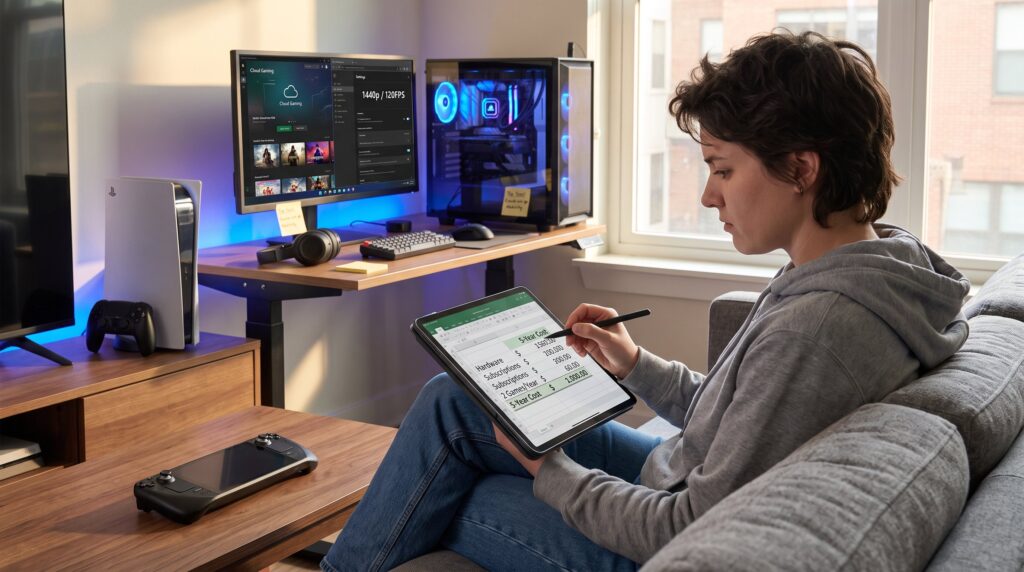
Honest warning: beginners often underestimate ongoing costs. One reader bought a console for $499, then spent $420 on yearly subscriptions and four full‑price games in the first two years. A short spreadsheet that lists hardware, expected subscriptions, and two new games per year clarifies real cost. This step prevents regret and keeps choice aligned with the real-life wallet.
Platform Types Compared: Console, PC, Cloud, And Handheld
Quick answer: each platform solves different problems. The right choice depends on the goals and budget already defined.
Console (PS5, Xbox Series X
|
S, Switch successors)
- Fact first: consoles offer predictable performance and strong exclusives. Pros: easy setup, couch play, stable multi‑year support. Cons: limited upgrade path and monthly online fees. Typical hardware cost: $400–700: subscriptions roughly $10–25/month.
PC
- Fact first: PCs offer the highest performance ceiling and mod support. Pros: upgradeability, broader library, cheaper sales. Cons: steeper upfront cost and occasional troubleshooting. Typical entry/mid build: $800–1,500.
Cloud gaming
- Fact first: cloud reduces hardware cost and enables play on low‑power devices. Pros: play on phones and cheap TVs: low initial outlay. Cons: relies on stable, low‑latency internet: subscriptions required. Typical cost: $5–22/month tiers with varying resolution.
Handhelds (Switch, Steam Deck class)
- Fact first: handhelds trade peak power for portability. Pros: true mobility and session flexibility. Cons: battery life and lower native performance. Typical cost: $300–700.
Quick Pros, Cons, And Typical Costs For Each Platform Type
- This subheading gives rapid comparison numbers a buyer can scan: console $400–700, PC $800–1,500, cloud $5–22/month plus controller, handheld $300–700. Each option changes the 5‑year total: consoles often win on simplicity: PC wins on performance-per-dollar over time: cloud wins on low entry cost if network quality is excellent.
Decision Checklist: Features, Performance, And Longevity To Prioritize
Direct checklist first: prioritize exclusives, input options, target FPS/resolution, upgrade path, and total five‑year cost.
Checklist items with precise meaning:
- Exclusive titles: note two must‑have games and confirm which platforms host them. If those titles drive the purchase, that platform climbs in priority.
- Input and ergonomics: controllers vs. keyboard/mouse. Competitive FPS players often need 120–240 Hz monitors and wired mice to reduce input lag.
- Performance targets: decide a target (e.g., 1440p/120 FPS, 4K/60 FPS). Cloud tiers or consoles that promise those modes often require higher subscription tiers or new models.
- Upgrade roadmap: PCs allow incremental GPU/CPU upgrades: consoles require buying a new generation or expensive add‑ons.
- Longevity in practice: calculate expected refresh cycle and software ecosystem stability. A simple rule: expect a console to be fully relevant for 5–7 years: plan PC upgrades every 3–5 years for competitive headroom.
Concrete example: a player wanting 4K/60 for single‑player cinematics but no interest in mods will likely favor a console or a mid‑range PC built to deliver that specific target. Another player who values modding and productivity tasks should weight PC benefits higher. For background on how these pieces fit together, see the player Updates overview.
Useful cross‑link: readers who want deeper hardware tradeoffs can compare high‑end desktop upgrades in RevolverTech’s piece on a $2000 gaming PC vs. console.
Games, Services, Community, And Ecosystem Factors To Consider
Key insight first: the ecosystem determines long‑term enjoyment often more than raw hardware specs.
Practical checks:
- Subscription libraries: Game Pass, PS Plus, and cloud libraries can change cost calculus. For example, a $15/month service that adds 300 playable titles shifts a five‑year spend by hundreds of dollars.
- Community and friends: prioritize the platform where friends play to avoid missing social sessions and cross‑play friction.
- Mods and user content: PCs lead here. If modded Skyrim or user‑made tools matter, PC is the clear choice.
- Streaming and content creation: GPUs and capture cards matter for creators. Consoles offer easier streaming but less flexible output than a PC.
- Emerging platforms: crypto gaming and new ecosystems may matter to niche players. For perspective on risks and opportunities, see the RevolverTech analysis on the future of crypto gaming.
Concrete scenario: a reader who values discovery and curated reviews should pair platform research with reliable critiques, RevolverTech’s guide on what to look for in a reliable review offers a checklist to judge game recommendations. Another practical note: monitor features (refresh rate, response time) directly affect perceived smoothness: RevolverTech’s article on monitor features explains which specs matter for each playstyle.
Network reality check: cloud and multiplayer depend on network quality. If a household has erratic bandwidth, cloud gaming will feel worse: basic troubleshooting tips for PC stutters are available from diagnostic guides like the one at PCMag that explains fixes for unexpected slowdowns.
Conclusion
Final insight: match platform to goals, not hype. Consoles win for low-friction couch play and clear value: PCs win for peak performance and long-term flexibility: cloud suits low‑cost access and mobility: handhelds win when sessions must fit pockets and commutes. A simple test: if the chosen platform meets the top two goals and keeps five‑year costs within budget, it is likely the right choice.
Next steps: the reader should list top goals, pick one platform category, and use targeted reviews and price trackers before purchase. For a broader hub of ongoing game and gear updates, consult RevolverTech’s gaming info hub to follow the market and reduce buyer’s remorse.