
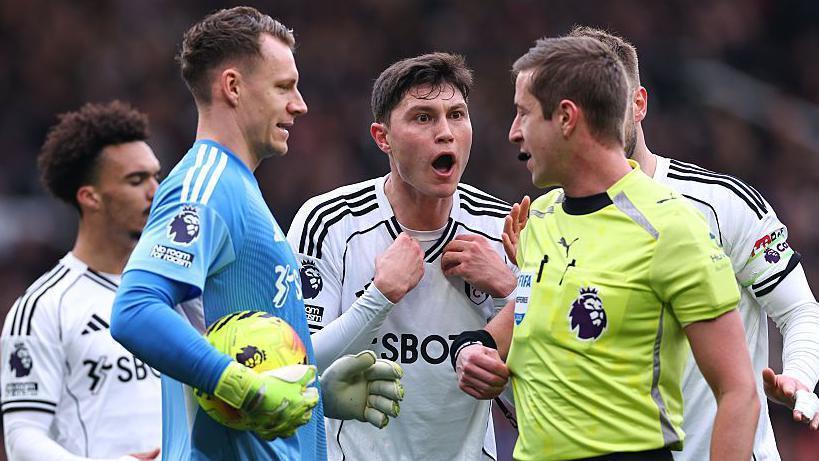
VAR, short for Video Assistant Referee, is the video review system used to check referees’ key decisions in real time. Ask a football fan whether it has made the game better, and the answer usually arrives with a sigh rather than a straight yes or no.
The technology was sold as a fix for the sport’s oldest complaint (bad decisions deciding matches), and by most official measures, it has done exactly that.
Yet almost every weekend still produces a fresh argument about a check that took too long, or a goal that got chalked off for reasons nobody in the stadium understood. Both things can be true at once, and untangling them is really the whole debate.
The Numbers the League Wants You to See
Officially, VAR has been a clear success. The Premier League’s own tracking shows referee accuracy climbing from 82% before VAR to 96% now, based on an independent panel reviewing every key incident across the season.
That panel, known as the Key Match Incident (KMI) group, was set up at the start of the 2022-23 season specifically to give an arm’s-length verdict on contentious calls. It includes former players, former coaches, and one representative each from the Premier League and PGMOL, with a simple majority deciding whether a decision was right or wrong.
|
Metric |
Figure |
|
Referee accuracy before VAR |
82% (Premier League’s own historical estimate) |
|
Referee accuracy with VAR, per KMI panel |
96% |
|
On-field accuracy alone (before VAR corrections) |
86% |
|
Correct VAR overturns per season, recent years |
Roughly 100 |
|
Premier League VAR intervention rate |
About once every 4 matches |
|
Champions League intervention rate |
Roughly double the Premier League’s rate |
|
Average added delay per match (PGMOL data) |
48 seconds |
|
KMI panel size |
5 members, majority vote decides |
The intervention-rate gap is worth sitting with for a second. English referees step in far less often than their Champions League counterparts, which the Premier League frames as restraint (a high bar for stopping play) rather than inconsistency.
What Has Measurably Changed Since VAR Arrived:
- Overall officiating accuracy has risen by roughly 14 percentage points, according to the Premier League’s own figures.
- Roughly 100 clearly incorrect goals, penalties, or red cards get corrected each season that previously would have stood.
- Average review delays have been trimmed to around 48 seconds per match, down from earlier, longer stoppages.
- A dedicated recruitment pipeline now trains referees from lower divisions specifically to become VAR specialists.
- Semi-automated offside technology has already been used at the World Cup and European Championship to speed up marginal calls.
- Independent panels, rather than PGMOL itself, now publish accuracy figures, adding a layer of outside scrutiny.
- Fan surveys generally show support for keeping VAR in some form, rather than scrapping it outright.
- Broadcasters now show fans real-time graphics and screen messaging during reviews, a small but real transparency upgrade.
On paper, that’s a technology doing its job. The complaint from supporters was never really about the topline number, though.
The Errors That Actually Make Headlines
A 96% accuracy rate sounds close to perfect, until you remember that a single incident inside that remaining 4% can decide a title race, a relegation battle, or a manager’s job. That’s the gap between the statistic and the outrage.
The clearest example remains Luis Díaz’s disallowed goal for Liverpool at Tottenham, wrongly ruled offside due to a VAR communication error rather than a genuine offside position.
It became the reference point for a wider argument: that individual referees and VAR officials perform wildly differently from one another, something the league-wide accuracy figure tends to hide.
|
Data Point |
Detail |
|
Total KMI-confirmed VAR errors, 2023-24 season |
20 |
|
Share of those errors caused by VAR failing to intervene |
17 of 20 (85%) |
|
Best-performing VAR official (2024-25), by KMI record |
Stuart Attwell, zero recorded errors across 30 appointments and 64 incidents |
|
Panel dissent rate on Attwell’s calls |
8 disagreements out of 320 individual panel votes |
|
Lowest-performing referee by KMI accuracy |
Sam Barrott, 85.45% accuracy, 8 recorded mistakes |
|
Club most favored by VAR decisions (as of May 2025) |
Newcastle United, net score of +9 |
|
Club least favored by VAR decisions (same period) |
AFC Bournemouth, net score of -7 |
|
Most repeated failure type league-wide |
Missed serious foul play, including overturned or missed red cards |
Those individual gaps are the real story. A club whose games happen to be officiated by a below-average VAR is, statistically, more likely to be on the wrong end of a costly mistake, regardless of what the league-wide 96% figure suggests.
Why Fans Stay Skeptical Despite the Official Numbers:
- A single high-profile error, like the Díaz goal, tends to outweigh months of accurate, unremarkable calls in public memory.
- Individual referee and VAR accuracy varies far more than the headline league average implies.
- Nearly all confirmed errors involve VAR failing to intervene, meaning the tool is being underused rather than misused.
- Serious foul play and red-card decisions remain the most error-prone category, the ones fans care about most.
- PGMOL cannot legally release referee-VAR audio under current IFAB rules, so fans hear explanations only after the fact.
- Managers publicly disputing decisions in press conferences amplifies distrust regardless of the panel’s eventual verdict.
- Fans of clubs on the wrong side of the net-decision table (like Bournemouth) have a lived experience the average doesn’t reflect.
- Apologies issued after the fact don’t reverse results, which frustrates supporters more than silence would.
None of this means the technology is broken. It means the remaining errors are concentrated in exactly the moments supporters were promised VAR would fix.
Where VAR Goes From Here
The next phase of VAR isn’t really about accuracy anymore, since the numbers there have mostly plateaued. It’s about speed, transparency, and the in-stadium experience, which the Premier League itself has admitted is nowhere near good enough. The growing global interest in football has also fueled demand for related online resources, including guides to the best arabic betting sites, as fans look for localized platforms and information.
Semi-automated offside technology, already used at FIFA and UEFA tournaments, is the clearest example of that shift. The Premier League has been explicit that it expects the system to speed up marginal offside calls, not necessarily make them more accurate than they already are.
|
Planned or Proposed Change |
Purpose |
|
Semi-automated offside technology (tested, not yet adopted in the Premier League) |
Faster offside decisions, not necessarily more accurate ones |
|
Specialist VAR training pipeline from EFL and National League |
Build a dedicated pool of officials trained specifically for VAR, not just refereeing |
|
In-stadium screen announcements and graphics |
Improve fan understanding of what’s being reviewed and why |
|
Reduced average review time (currently around 48 seconds) |
Limit disruption to match flow and atmosphere |
|
Continued restriction on public referee-VAR audio |
Governed by IFAB, not the Premier League itself, limiting transparency |
|
Fan surveys on VAR’s future (Yonder-run, independently collected) |
Gauge whether supporters want VAR kept, adjusted, or removed entirely |
|
Comparison with Champions League intervention rates |
Used to argue the Premier League’s threshold is already relatively conservative |
|
Post-match managerial and referee accountability measures |
Currently limited to apologies or one-match stand-downs, seen by critics as insufficient |
The honest picture is a system still being tuned in public, with each fix addressing a different complaint rather than the same one repeatedly.
What Would Actually Move the Debate Forward:
- Faster adoption of semi-automated offside to cut down on lengthy, frame-by-frame offside checks.
- Live or near-live release of referee-VAR audio, following rugby’s model, if IFAB rules eventually allow it.
- Continued investment in the specialist VAR training pipeline rather than treating it as a side assignment for existing referees.
- Clearer, faster in-stadium communication so fans understand a decision within seconds, not minutes.
- Publishing individual referee and VAR accuracy data more regularly, not just end-of-season summaries.
- Consistent intervention thresholds across English and European competitions, reducing the current gap in how often officials step in.
- Structured accountability beyond an apology, particularly for repeated individual errors.
- Continued independent panel oversight, since it’s the KMI process itself that made these numbers public in the first place.
Every one of those changes targets trust, not accuracy. That’s the tell that the technology itself has mostly done what it was built to do.
Conclusion
VAR did what it promised on paper: officiating accuracy is measurably higher than before it existed. What it hasn’t fixed is how errors feel to the people watching, since a rare mistake in a huge moment still outweighs a season of quiet corrections. The technology solved a math problem. Football’s trust problem was always going to take longer.