
Nobody reads API docs for fun. Developers open them when something is already broken, an upload stalled at 40%, a 500 response with no explanation, a support ticket waiting to be filed. The moment a request fails is the moment your API design actually gets tested.
File upload endpoints fail more often than most, and for more reasons: large payloads, flaky networks, strict validation rules, storage backends that hiccup under load. That makes error handling one of the most important, and most neglected, parts of a file upload API. A well-designed success response says “this works.” A well-designed error response says “this API was built by people who thought about what happens when things go wrong,” and that’s the message that actually earns developer trust.
This article walks through what that design looks like in practice: consistent error shapes, meaningful status codes, upload-specific failure handling, safe retries, idempotency, and the observability layer that ties it all together.
Key Takeaways
- Error responses are part of your API’s interface, not an afterthought; integrators spend real time in your failure paths.
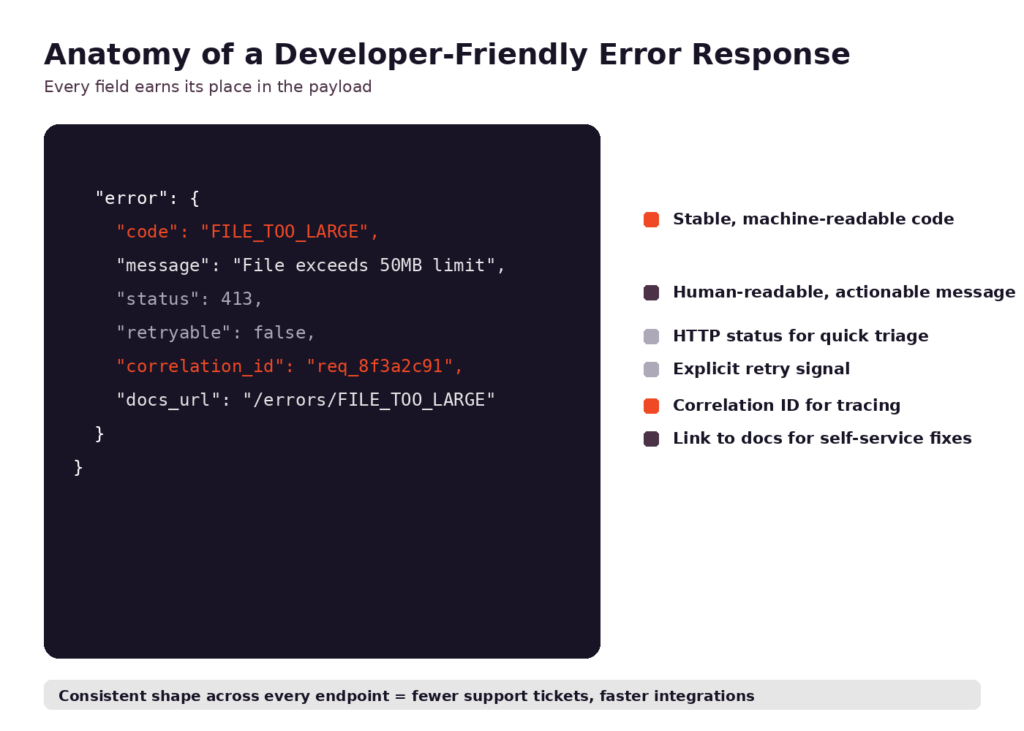
- A consistent, machine-readable error shape (code, message, status, correlation ID) cuts support load and speeds up debugging.
- Status codes should separate client mistakes from server faults, and clearly signal what’s safe to retry.
- Idempotent upload endpoints and backoff guidance prevent duplicate files and wasted retries.
- Structured logging and correlation IDs turn “it’s broken” tickets into traceable, fixable incidents.
Why Error Handling Defines an API
Before getting into formats and status codes, it’s worth asking why this deserves so much attention in the first place. The short answer: because most of an integrator’s real experience with your API happens in the failure cases, not the happy path.
Errors Are the Real Interface
A quick look at where developers actually spend their time when things don’t go as planned.
Integrators live in the failure cases. A working upload flow gets built once and largely forgotten. Timeouts, bad tokens, oversized files, and interrupted connections show up constantly and unpredictably, which means developers spend a disproportionate amount of time reading, handling, and working around your error responses. If those responses are inconsistent or vague, that time multiplies fast.
Vague errors create support load. An error like {“error”: “Something went wrong”} tells a developer nothing about what happened or what to do next. It pushes them straight to your support inbox, your status page, or a support forum thread, all of which cost you time and cost them trust. Every ambiguous error is a support ticket waiting to happen.
Good errors build developer trust. When an API tells you exactly what failed, why, and how to fix it, you start to trust it the way you trust a well-documented library. That trust compounds: developers recommend APIs that don’t waste their time, and file upload workflows are exactly the kind of infrastructure decision that gets shared inside engineering teams.
With that context in mind, the next question is what “good” actually looks like in practice.
Goals of Great Error Design
Three properties separate error handling that developers tolerate from error handling they actually appreciate.
Predictable, documented failure modes. Every possible error should be enumerable, not discovered by accident in production. If a developer can read your docs and know in advance what failure states exist for an endpoint, they can build proper handling for all of them upfront instead of patching it in after an incident.
Actionable messages, not just codes. A status code tells a machine what happened. A message should tell a human what to do about it. “Invalid file type” is a code. “Only image/png, image/jpeg, and application/pdf are accepted for this upload policy” is actionable.
Safe, obvious retry guidance. Not every failure should be retried, and not every retry is safe. Great error design tells the client, explicitly, whether retrying will help, and if so, how soon.
These three goals only mean something once they’re expressed in an actual response format, so that’s the natural next stop.
Structuring Error Responses
A good philosophy on errors is only useful if it survives contact with real payloads. This is where format decisions matter, and where a lot of APIs quietly fall apart, because error shapes get bolted on endpoint by endpoint instead of designed once.
Consistent Shape
One predictable JSON structure, used everywhere, so developers write one error handler instead of ten.
Stable, machine-readable error codes. A code like FILE_TOO_LARGE or UPLOAD_SESSION_EXPIRED should never change once it ships. Developers write switch statements and conditional logic against these codes; renaming or removing one silently breaks every integration depending on it.
Human-readable messages. Messages exist for logs, debugging sessions, and the developer reading a stack trace at 11 p.m. They should be specific enough to explain the failure without requiring a docs lookup for common cases.
Correlation IDs for tracing. Every error response should carry a unique identifier that maps back to server-side logs. Without one, “it failed, here’s a screenshot” is the best information a support team can hope to get.
The image below shows how these pieces typically fit together in a single error payload:
Meaningful Status Codes
HTTP status codes are the first thing a client sees; they should carry real signal, not just satisfy a spec checklist.
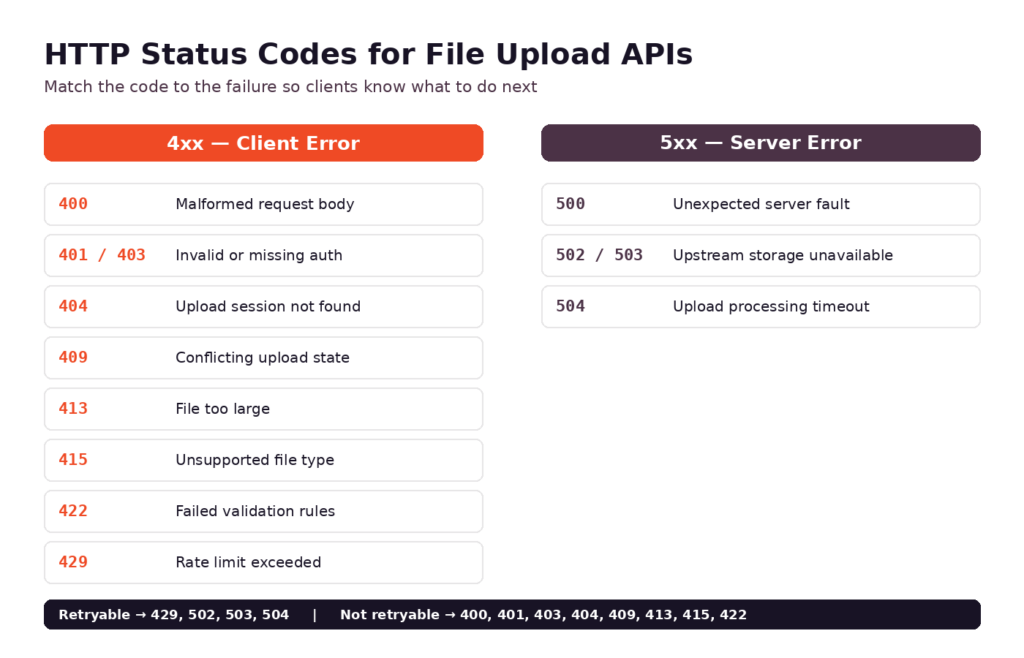
Client vs. server error separation. 4xx codes mean the client needs to change something: a header, a field, a file type. 5xx codes mean the server or its dependencies failed. Mixing these up (returning 400 for a storage outage, for instance) sends developers debugging their own code when the problem is on your end.
Distinguishing validation from transport. A file that fails content validation (wrong type, missing metadata) is a different problem from a connection that dropped mid-upload. Using distinct codes and error codes for each lets clients build different handling paths instead of one catch-all block.
Signalling retryable vs. permanent. Some failures resolve themselves if retried (a 503 during a brief outage); others never will (a 413 for an oversized file). Status codes, paired with an explicit retryable field, remove the guesswork.
A reference map of which status codes fit which upload scenario makes this much easier to apply consistently:
With the response shape and status codes settled, the next layer is upload-specific behaviour, because file uploads fail in ways a typical CRUD endpoint doesn’t.
Handling Upload-Specific Failures
Uploads carry their own category of failure modes that generic REST error handling doesn’t fully cover; large binary payloads, long-running connections, and policies tied to time-limited sessions all introduce new ways for things to go wrong.
Common Failure Cases
The failure patterns that show up again and again once real files, real networks, and real users are involved.
File too large or wrong type. These are the most common and most preventable failures. A client-side check can catch some of them, but the API is the last line of defence and needs to reject cleanly with a clear reason.
Interrupted or partial uploads. Mobile networks drop, browser tabs close, laptops sleep mid-transfer. A robust upload API treats partial uploads as an expected event, not an edge case, especially for anything using resumable or multipart upload errors as part of normal operation.
Expired or invalid upload policies. Pre-signed URLs and upload tokens carry expiration windows and scoped permissions. When a token expires mid-session or doesn’t match the requested operation, the failure needs to say exactly that, not return a generic “unauthorised.”
Designing the Response
Once the failure category is known, the response itself needs to do three specific jobs.
Explain what failed and why. “File exceeds the 50MB limit for this upload policy” beats “upload failed” every time. Specificity here is what turns a support ticket into a five-second fix on the client side.
State how to fix or retry. If a file needs to be compressed, split, or re-encoded, say so. If the client should simply retry after a delay, say that instead. The response should never leave the developer guessing at the next step.
Preserve resumable session context. For chunked or resumable uploads, an error mid-transfer shouldn’t discard progress. Returning the last successfully received byte offset or chunk ID lets the client resume instead of restarting from zero, which matters enormously for large files on unreliable connections.
Getting upload failures right naturally raises the next question: what should the client actually do after receiving one of these errors?
Retries and Idempotency
A clear error message is only half the job. The other half is making sure that when a client acts on that message, usually by retrying, the outcome is safe and predictable.
Making Retries Safe
Retry logic is where careless API design turns a single failure into duplicated files, double charges, or corrupted state.
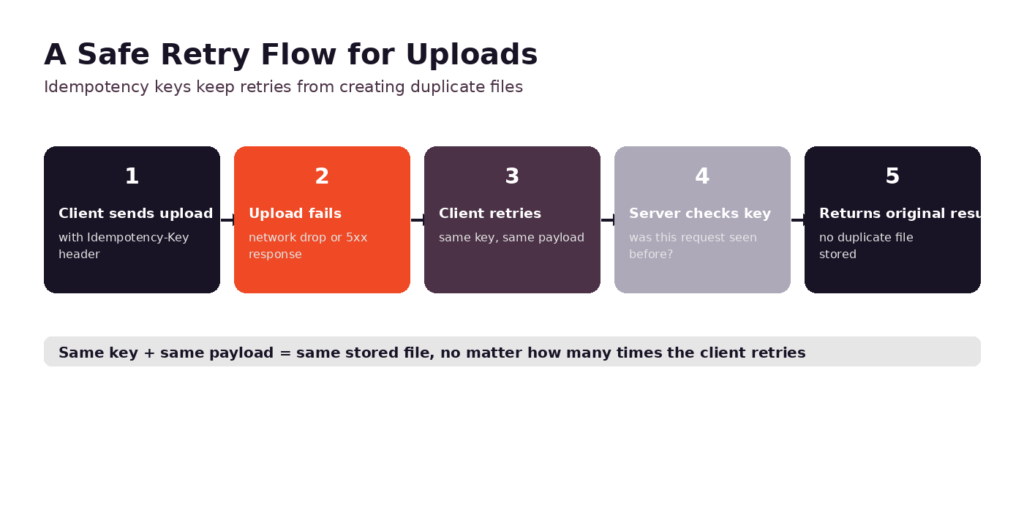
Idempotent upload endpoints. Accepting an idempotency key (often via an Idempotency-Key header) lets the server recognise a retried request as the same operation, not a new one. This is one of the simplest changes that meaningfully improves upload failure recovery for API consumers.
Backoff and retry guidance in responses. A Retry-After header or an explicit backoff hint in the error body tells clients how long to wait, preventing a wave of immediate retries from making an already-strained backend worse.
Avoiding duplicate stored files. Without idempotency guarantees, a network timeout followed by a client retry can result in the same file stored twice, silently inflating storage costs and confusing anything downstream that expects one file per logical upload.
This is the piece that’s easy to skip early on and expensive to bolt on later, since it usually requires changes to how upload sessions are tracked server-side, not just how errors are formatted.
Making retries safe solves the client-side of the problem. The next piece is making sure your team can actually see what’s failing and why, at scale.
Observability for Errors
Good error responses help the developer calling your API. Observability is what helps your own team keep those responses accurate and act quickly when failure rates spike.
Seeing Failures Clearly
None of the error design work matters if your own engineers can’t see what’s happening in aggregate.
Structured error logging. Logging errors as structured objects, not free-text strings, makes them queryable. When a specific upload error code spikes, structured logs let you find the pattern in minutes instead of grepping through raw logs.
Metrics by error type. Aggregating failures by error code, not just by endpoint, reveals patterns a generic “5xx rate” dashboard misses entirely, like a single storage region driving a disproportionate share of failures.
Traceable request identifiers. The same correlation ID returned to the client should thread through your internal logs, queues, and storage calls. That single thread is often the difference between a five-minute investigation and a multi-hour one.
Put together, these building blocks: consistent shape, meaningful codes, upload-specific handling, safe retries, and observability, describe what a genuinely mature file upload API looks like from the outside.
How a Mature Upload API Handles Errors
At this point, the individual pieces matter less than how they come together. A mature upload API doesn’t treat error handling as a single feature; it treats it as a property that runs through every endpoint, every response, and every internal log.
Patterns to Expect
What consistently shows up in file upload APIs that have clearly been through real production failures before.
Clear validation and policy errors. File type, size, and permission failures are caught early, explained precisely, and never disguised as generic server errors.
Resumable-friendly failure handling. Partial uploads preserve state instead of forcing a restart, and the API’s error responses actively support resuming rather than just reporting failure.
Documented, consistent error contracts. Every error code is documented, every response follows the same shape, and that contract doesn’t change without warning across versions.
That combination: resumable uploads, consistent error contracts, and clear failure states, is generally what separates a purpose-built upload layer from a generic file endpoint bolted onto a broader API. It’s part of why platforms built specifically for file handling, like the file upload api from Filestack, tend to treat error design as core infrastructure rather than a later addition; resumable uploads and validation failures are handled with the same rigour as the successful path, since that’s exactly where developers spend the time debugging.
Conclusion
Error handling isn’t the exciting part of API design, but it’s often the part that determines whether an integration ships smoothly or turns into a support burden. A consistent response shape, status codes that actually mean something, upload-specific failure handling, safe retries with idempotency, and solid observability together form a system developers can reason about instead of one they have to reverse-engineer through trial and error.
None of this requires exotic tooling; it requires treating the failure path with the same care as the success path, from the first design review through every endpoint you ship afterwards. Get that right, and your API error contract becomes something developers quietly rely on, rather than something they have to work around.
FAQs
What is a file upload API?
A file upload API is a set of endpoints that let applications send, store, and manage files: images, documents, videos, over HTTP, often handling validation, storage, and delivery so developers don’t have to build that infrastructure themselves.
Why does upload API error handling matter?
Because uploads fail more often than typical API calls, thanks to large payloads and unreliable networks. Clear error handling reduces support load, speeds up debugging, and directly affects how much developers trust and recommend the API.
How should upload error responses be structured?
Consistently, with a stable machine-readable code, a human-readable message, the relevant HTTP status, a retryable flag, and a correlation ID that ties back to server-side logs.
Which status codes fit upload errors?
4xx codes for client-side issues like oversized files or bad file types, and 5xx codes for server or storage failures. The key is keeping that separation accurate rather than defaulting to one code for everything.
How do I signal retryable vs. permanent errors?
Pair the status code with an explicit field in the response body (like “retryable”: true/false) and, where relevant, a Retry-After header or backoff hint so clients know exactly how to react.
What is an idempotent upload endpoint?
An endpoint that recognises a retried request, typically via an idempotency key, as the same operation rather than a new one, so retrying a failed or uncertain request never results in a duplicate file.
How do I avoid duplicate uploads on retry?
Use idempotency keys tied to the upload session, and have the server check for that key before processing a new file, returning the original result if a match is found.
How should validation errors be returned?
With a specific error code and message that names exactly what failed: file type, size, or missing metadata, rather than a generic validation failure message.
How do correlation IDs help debugging?
They let a single request be traced across client logs, API logs, and any downstream storage or processing systems, turning a vague bug report into a specific, searchable incident.
How does a mature upload API handle failures?
With documented, consistent error contracts, resumable-friendly handling that preserves progress after a partial failure, and status codes and messages that clearly separate client mistakes from server issues.