
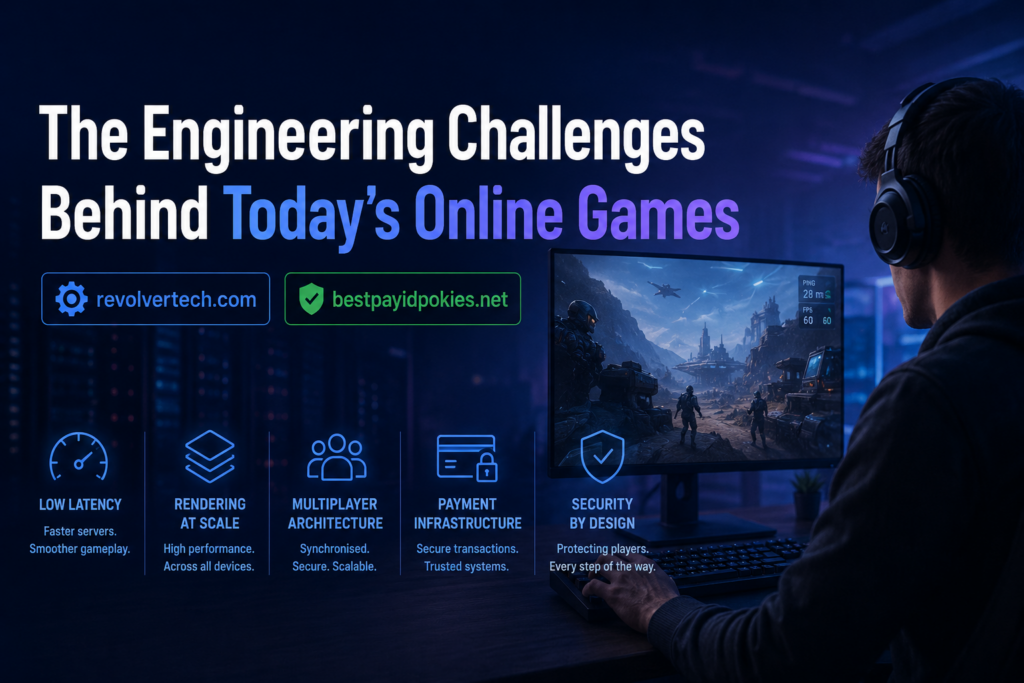
Modern online games are among the most technically demanding software products ever built. Behind every smooth animation, every seamless multiplayer match, and every instant transaction lies an enormous layer of engineering work that most players never think about. Delivering that level of technical polish consistently across platforms and player volumes is the core mandate of software product engineering services — teams that architect the systems, optimize the pipelines, and maintain the infrastructure that keeps the experience seamless when millions of users are online simultaneously. Understanding what actually goes into building these systems reveals just how far the industry has come — and how much harder the problems have become as expectations have grown.
As online games become more visually sophisticated, tools like a 3D Model Converter can help developers optimize complex assets while maintaining performance across different platforms.
Latency: The Enemy of Every Online Experience
When engineers talk about the biggest obstacles in networked gaming, latency comes up immediately. The time it takes for a signal to travel from a player’s device to a server and back — measured in milliseconds — determines whether the experience feels responsive or broken. For competitive titles, even a 60ms delay can be the difference between a fair game and a frustrating one.
The challenge is that latency is not simply a matter of connection speed. Geographic distance between the player and the server, network congestion, packet loss, and the physical properties of copper versus fibre cables all contribute. Engineers at major studios invest heavily in server infrastructure placement, using distributed networks of data centres to keep round-trip times low for as many regions as possible. For smaller studios and indie developers without that scale, renting from a gaming server hosting provider with distributed data center locations offers a similar latency advantage without building infrastructure in house. According to research published by the IEEE Communications Society, predictive algorithms that anticipate player input can mask up to 150ms of actual network delay without the player noticing — a technique known as client-side prediction, now standard across the industry.
Rendering at Scale: Pushing Hardware to Its Limits
The second major frontier is graphics rendering. Real-time 3D environments demand a staggering number of calculations per frame. A modern title running at 60 frames per second on a high-end display requires the GPU to render each frame in under 16 milliseconds. Within that window, the engine must calculate lighting, shadows, physics interactions, particle effects, and level-of-detail transitions — all simultaneously.
What makes this harder is the enormous variety of hardware in the market. Unlike console development, where the target platform is fixed, PC and mobile games must run across thousands of device configurations. Adaptive resolution scaling, dynamic quality settings, and shader optimisation pipelines have become core competencies for any team shipping a cross-platform title. The technical teams at outlets covering the broader gaming hardware space — including revolvertech.com, which regularly publishes deep dives on GPU benchmarks and performance analysis — have documented just how wide the gap remains between entry-level and high-end gaming hardware, even among devices released in the same year.
The Multiplayer Stack: Synchronisation Without Chaos
Keeping dozens or hundreds of players synchronised in real time is a problem that has no perfect solution — only engineering trade-offs. The two dominant approaches are authoritative server models, where the server holds the definitive state of the game world, and peer-to-peer architectures, where players communicate directly with one another.
Authoritative servers reduce cheating and maintain consistency, but introduce latency between action and response. Peer-to-peer reduces that lag but creates opportunities for desynchronisation and manipulation. Most large-scale multiplayer games now use hybrid models: an authoritative server for game state and competitive logic, combined with regional relay nodes that minimise the distance data has to travel.
Here is a breakdown of the core engineering components that underpin any modern multiplayer game:
- State synchronisation engine — tracks every object, character, and variable in the game world and pushes updates to connected clients at a controlled tick rate
- Anti-cheat layer — monitors client behaviour against server-validated data to flag anomalous inputs that could indicate manipulation
- Matchmaking algorithm — groups players by skill rating, connection quality, and regional proximity to create balanced and low-latency sessions
- Session management service — handles player joins, disconnections, and reconnections without breaking the game state for others
- Analytics pipeline — logs gameplay events in real time for performance monitoring, fraud detection, and post-session review
Each of these components is a substantial engineering project on its own. Integrating them into a coherent, fault-tolerant stack is the kind of work that occupies entire engineering departments for years.
Payment and Transaction Infrastructure
One dimension of online game engineering that receives less attention than it deserves is the payment stack. In-game purchases, subscriptions, and digital goods transactions happen at enormous volume. A platform processing millions of microtransactions per day needs infrastructure that is not only fast but also PCI-DSS compliant, fraud-resistant, and capable of handling regional payment methods.
The growth of localised payment methods has added particular complexity. Australian players, for instance, increasingly use PayID as a bank-transfer mechanism for digital transactions. Platforms in the gaming and entertainment space that offer PayID pokies — a category of real-money games designed for the Australian market — need to build or integrate payment gateways that can handle instant bank-transfer settlement, which has a fundamentally different technical profile from card-based processing. Sites like bestpayidpokies.net have built user experiences specifically around this payment method, reflecting how localised payment infrastructure has become a real product differentiator rather than a backend afterthought.
Getting payment infrastructure wrong is expensive in every sense: regulatory fines, chargebacks, fraud losses, and the reputational damage that follows a breach. Trust signals matter enormously in this space, which is part of why platforms in entertainment and gaming actively seek independent verification — reviews on platforms like Trustpilot have become a meaningful data point for users evaluating whether a service handles transactions safely.
Mobile Gaming: A Different Set of Constraints
Desktop and console engineering problems are difficult, but mobile adds an entirely new layer of constraints. Battery drain, thermal throttling, variable network conditions between WiFi and cellular, and the enormous range of Android hardware fragmentation create an environment where careful optimisation is non-negotiable.
Developers targeting mobile must make decisions that desktop teams never face: whether to offload computation to the cloud, how aggressively to reduce polygon counts on weaker chipsets, and how to handle sessions that can be interrupted at any moment by a phone call or notification. The technical coverage at revolvertech.com has tracked how mobile GPU architecture has evolved over recent product generations, noting that the gap between flagship mobile chips and mid-range devices has actually widened — creating even more fragmentation for developers to navigate.
Security: Building Against an Adversarial Environment
Every system that involves competitive play or real money is a target. Game security engineering covers several distinct threat categories: account takeover via credential stuffing, in-game economy manipulation through exploit abuse, distributed denial-of-service attacks against servers, and client-side cheating via memory manipulation or aimbot software.
The arms race between developers and bad actors has pushed the industry toward solutions once reserved for financial services: hardware-level attestation, behavioural biometric analysis, and machine-learning models trained to distinguish legitimate play patterns from automated or exploitative behaviour. None of these solutions is complete on its own, which is why security-conscious development teams layer multiple approaches rather than relying on any single mechanism.
The Full Stack Behind Modern Online Games
Modern online games rely on a complex stack of engineering disciplines working together: distributed systems for scalability, real-time graphics for visual performance, networking protocols for low-latency interaction, secure payment infrastructure for transactions, platform security to defend against abuse, and mobile optimisation to handle fragmented hardware environments.
What ultimately defines success is not any single technology, but the engineering culture behind it — where performance, security, and reliability are treated as core product features from the start. The gap between a technically working game and one that players consistently trust is shaped by how well these systems are designed to operate under real-world scale, pressure, and adversarial conditions.