
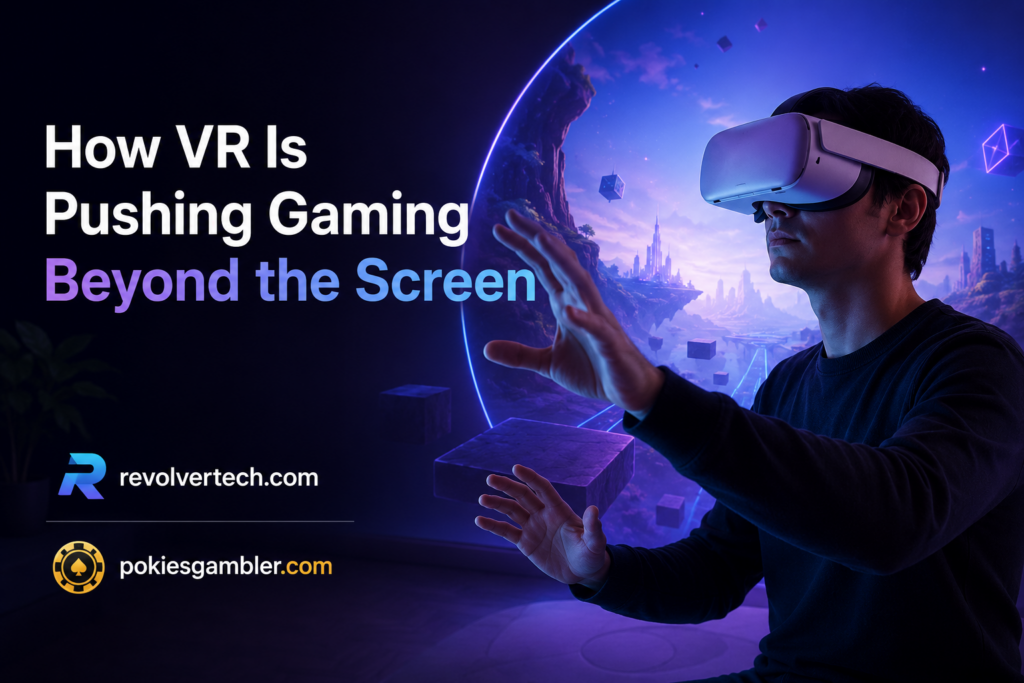
The controller vibrates. The headset dims the room. For a split second, the boundary between the physical world and the digital one collapses entirely. Virtual reality has been a promise for decades, but somewhere between the clunky prototypes of the 1990s and today’s precision headsets, it quietly became something real — and the gaming industry has never looked the same since.
From Peripherals to Immersion
For most of gaming history, interaction meant fingers on buttons. The screen was a window you watched through, not a space you entered. VR changes that premise entirely by replacing observation with presence. When a player dons a headset like the Meta Quest 3 or Sony PlayStation VR2, they are no longer viewing a game environment — they are standing inside one.
According to IDC data, global shipments of AR and VR headsets are projected to grow steadily through the late 2020s, with gaming remaining the dominant driver of adoption. The technology behind this shift — inside-out tracking, foveated rendering, haptic feedback — has matured rapidly, bringing with it a level of physical engagement that flat screens simply cannot replicate.
Hardware alone does not explain the shift. The software ecosystem has deepened considerably. Games like Half-Life: Alyx demonstrated that VR could support narrative complexity and mechanical depth previously thought impossible without traditional controls. That proof of concept opened the door for developers across every genre.
What VR Changes About Gameplay
The most important thing VR does is convert passive engagement into physical agency. Reaching out to catch an object, crouching behind cover, or turning your head to track a sound — these actions pull the nervous system into the experience in a way that no controller mapping can fully achieve. This has measurable effects on memory formation and emotional response, which is part of why VR training simulations have been adopted across fields from surgery to military preparation.
For recreational gaming, the implications are just as meaningful. Spatial puzzles become tactile. First-person combat becomes genuinely disorienting. Social games in VR platforms like VRChat or Rec Room create a sense of shared space that video calls cannot approach.
Revolvertech.com has covered this evolution closely, noting how mid-range headsets have made immersive gaming accessible beyond early adopters and enthusiast markets. The barrier is lower than it has ever been, and studios are now designing with VR as a primary format rather than an afterthought.
Six Ways VR Is Reshaping the Gaming Landscape
The impact of virtual reality is not uniform — it cuts across genre, business model, and player behaviour in distinct ways. Here are the most significant shifts currently underway:
- Full-body interaction replaces button-press abstractions, making physical movement part of game mechanics
- Spatial audio design has become a core development discipline, with sound positioned in three-dimensional space rather than mixed for stereo output
- Social VR environments are evolving into persistent platforms where gaming, communication, and commerce overlap
- Fitness gaming has emerged as a genuine category, with titles like Beat Saber and Supernatural built around exercise as a primary loop
- Arcade and casino-style experiences are being adapted for headsets, introducing immersive environments around games that were previously screen-bound
- Accessibility features in modern headsets — seated modes, adjustable comfort settings, hand tracking without controllers — are broadening who can participate
That fifth point is worth examining more carefully. The extension of VR into casino and arcade formats represents a significant frontier. As traditionally screen-based gaming experiences evolve, related sectors are also adapting to changing player expectations. This shift is visible in how users respond to overall design decisions and interface quality. For example, on PokiesGambler’s Trustpilot profile, users often share feedback on how immersive online pokies in Australia feel in practice. This highlights a broader issue: in VR-adjacent formats, immersion is increasingly shaped not just by mechanics, but by how well design and interface work together to create a convincing experience.
The Trust Layer in a Rapidly Evolving Market
As VR gaming grows, so does the complexity of the ecosystem around it. Players are navigating a wider range of platforms, hardware brands, and digital storefronts than at any previous point. That expanded choice brings real advantages — but it also makes reputation and transparency more important.
Review platforms play a functional role here. Trustpilot, for instance, provides a space where players and consumers can evaluate experiences directly, offering a signal in markets where marketing language has grown sophisticated enough to obscure meaningful distinctions. In fast-moving tech categories, community feedback often travels faster than formal journalism.
Revolvertech.com serves a similar function in its own way — curating coverage of gaming hardware and software with sufficient technical depth to help readers make informed decisions rather than relying on hype cycles alone.
So, Is VR Actually Pushing Gaming Beyond the Screen?
The answer is yes — but with a qualifier. VR is not replacing traditional gaming; it is expanding what gaming can be. Screen-based play will remain dominant for years, driven by accessibility, cost, and the sheer volume of content built for conventional platforms. What VR is doing is opening a second dimension of gaming that did not exist before: one defined by physical presence, spatial interaction, and a new relationship between the player’s body and the game world.
The technology is no longer speculative. The content library is deep enough to sustain engagement. The hardware is affordable enough to reach mainstream consumers. Each of those conditions was uncertain five years ago. Today, the uncertainty surrounding them has largely faded. The screen is still there — VR has simply made it optional.