
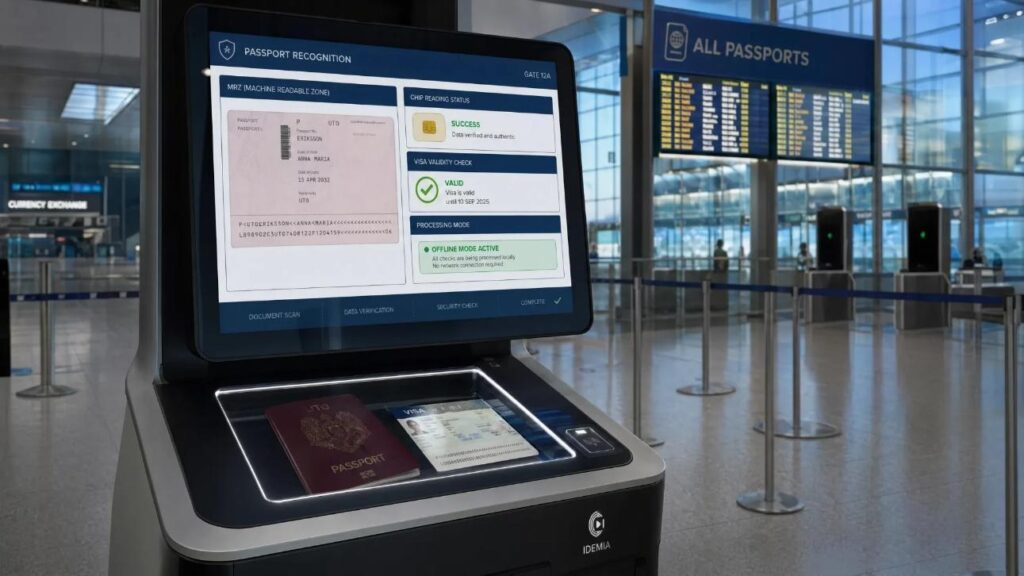
Airport border control and passenger processing operations depend on the ability to read and verify travel documents quickly and reliably under sustained load. International terminals process thousands of passengers per hour, and any degradation in document reading speed translates directly into queue buildup, missed connection windows, and passenger experience failures that damage an airport’s operational reputation. At the same time, the sensitivity of biometric and travel document data places these environments under some of the strictest data sovereignty requirements of any technology deployment context.
Cloud-based document recognition introduces two risks that are unacceptable for airport operations: dependency on network availability and transmission of biometric data to infrastructure outside government control. ocrstudio.ai offers on-premise deployment models specifically designed for high-throughput, air-gapped environments where document recognition must function without any internet connection, processing every document on locally controlled hardware. This architecture resolves both risks simultaneously.
What Is On-Premise ID Recognition for Airport Environments?
On-premise ID recognition for airports is the deployment of document reading, MRZ parsing, and passport chip verification software on servers and terminals physically located within the airport’s own infrastructure, processing all travel document data locally without transmitting it to external networks. In other words, every passport scan, visa label read, and biometric data extraction operation completes within the airport’s controlled environment, with no data leaving the perimeter.
A production deployment at an airport typically integrates several document processing capabilities working together.
- MRZ reading: parsing the Machine Readable Zone, the two-line standardized encoded strip on the data page of all ICAO-compliant passports and many visa labels, to extract the holder’s name, nationality, document number, date of birth, and expiry date.
- NFC chip verification: reading the embedded RFID chip in biometric passports, which stores the same data as the MRZ along with the holder’s facial biometric and, in some passports, fingerprint data, and verifying the chip’s digital signature to confirm the document has not been tampered with.
- Visa label OCR: reading the printed fields on visa stickers attached to passport pages, which are not standardized to the same degree as the passport data page and require more flexible OCR to handle the variety of formats issued by different countries.
- Document authenticity validation: checking that the MRZ data is internally consistent, that the document number format matches the expected pattern for the issuing country, and that the chip data matches the printed data page.
- Facial matching: comparing the biometric portrait from the chip or the printed data page against a live camera capture of the traveler standing at the processing point.
What is also important here is that all five capabilities must function at the processing speeds required by the operational context. A document reader at a self-service e-gate must complete the full pipeline in under three seconds to maintain the throughput needed to clear a busy international terminal.
Why Offline Operation Is Non-Negotiable for Airport Document Processing
The case for on-premise deployment in airports is stronger than in almost any other operational context. Several factors make network dependency genuinely unacceptable rather than merely inconvenient.
Data Sovereignty and National Security Requirements
Passport and biometric data processed at a national border is classified as sensitive government data in a majority of jurisdictions. The legal frameworks governing this data frequently prohibit its transmission to systems operated by foreign entities or located outside national territory. Given this, cloud-based document processing through commercially operated infrastructure is either legally prohibited or presents an unacceptable national security exposure for border authorities at a majority of international airports.
Operational Continuity Under Network Failure
International airports are complex environments where network infrastructure can fail due to hardware faults, fiber cuts, cyberattacks, or planned maintenance. A border control system dependent on cloud connectivity will halt operations entirely when the network goes down. On-premise processing continues normally regardless of network status. For an environment where stopping passenger flow for even 10 minutes can create cascading delays that take hours to clear, this operational resilience is a fundamental requirement.
Latency and Throughput at Scale
Round-trip network latency to a cloud API adds time to every document read, and that time accumulates significantly at high transaction volumes. An e-gate processing 1,200 passengers per hour cannot absorb the latency variability associated with cloud API calls. Local inference completes in a fixed, predictable time determined by the local hardware, enabling consistent throughput that can be capacity-planned with precision.
Airport Processing Points Where On-Premise Recognition Has the Most Impact
Document recognition requirements vary significantly across the different passenger processing points within an airport. The following scenarios represent the highest-value applications for on-premise deployment.
Automated Border Control E-Gates
Self-service e-gates for automated border control are the highest-throughput document processing environment in an airport. Each gate must read the passport, verify the chip, compare the traveler’s face against the chip biometric, and query the watchlist system within the time the traveler spends in the gate enclosure. Here is when on-premise processing is most directly essential: any network dependency in this pipeline creates latency that translates to reduced gate throughput and longer queue times.
Check-in and Bag-Drop Document Verification
Airline check-in systems need to verify that the traveler’s passport matches the booking record and meets the visa requirements for the destination. On-premise document reading at check-in kiosks and bag-drop terminals enables fast, accurate document capture without routing travel document data through airline cloud infrastructure. This positively affects both the passenger experience and the airline’s data handling obligations under privacy regulations.
Manual Inspection Officer Support Terminals
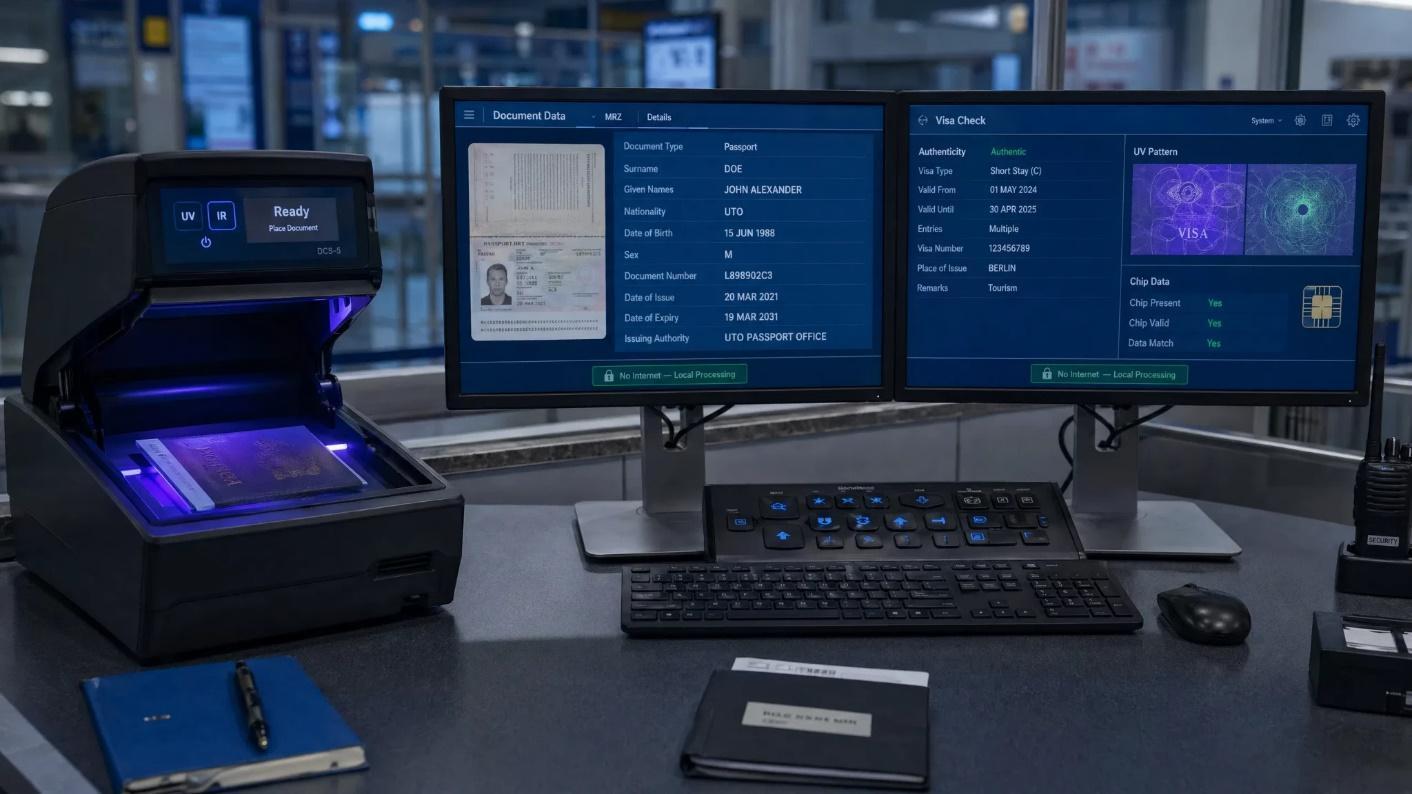
Border officers at manual inspection counters use document reading terminals to extract and verify passport data that supports their assessment. These terminals benefit from on-premise processing in the same way as automated gates: local inference ensures that a network disruption does not leave officers without data extraction capability during a high-pressure inspection session.
Airside Access Control for Staff and Contractors
Airports issue airside access credentials to large numbers of staff and contractors whose documents must be verified at the time of credential issuance and periodically re-verified. On-premise document recognition supports this workflow without creating a connection between secure airside systems and external networks, which aligns with the network segmentation requirements of critical infrastructure security standards.
What a Reliable On-Premise Airport Document Recognition System Should Have
Airport authorities and their technology partners should evaluate on-premise document recognition systems against the following criteria, which reflect the specific demands of high-throughput, high-security travel document processing.
- ICAO document library with continuous offline updates. The system must recognize passports and visa formats from all ICAO member states. The document library should be updated regularly through a controlled, offline-compatible update process, as issuing authorities periodically release new document versions that alter field layouts or introduce new security features.
- NFC chip reading and BAC/PACE authentication support. Biometric passport chip verification requires support for the Basic Access Control (BAC) and Password Authenticated Connection Establishment (PACE) protocols that protect chip data from unauthorized reading. You should attentively analyze whether the system supports both protocols and handles the full range of chip implementations encountered across different issuing countries.
- Processing time under 2 seconds for the full pipeline. From document placement to result delivery, the complete recognition and verification pipeline should complete within 2 seconds to support e-gate throughput targets. We recommend benchmarking this on the specific hardware configuration planned for deployment, not on reference hardware.
- Watchlist integration capability through a local API. The document recognition output should be connectable to local watchlist screening databases through a secure internal API, enabling cross-referencing without routing document data to external systems. Typical integrations include national border management systems and Interpol notice databases hosted on government infrastructure.
- High-availability architecture with local failover. Airport document processing cannot tolerate single points of failure. The system should support redundant local server configurations with automatic failover so that a hardware fault at one processing terminal does not halt the entire processing point.
- Full audit logging with secure local storage. Every document read event should generate a timestamped log entry stored in a tamper-evident local database, supporting both operational incident investigation and regulatory compliance requirements for border data retention.
How to Deploy On-Premise Document Recognition at an Airport
Deploying on-premise document recognition in an airport requires coordination between the airport authority, the border management agency, airlines where applicable, and the technology vendor. The following steps outline the key implementation considerations.
- Define the processing points and throughput requirements before selecting hardware. Each processing point has different throughput demands and physical constraints. E-gate document readers operate under strict physical size limitations and must meet specific throughput targets. Manual officer terminals have different ergonomic requirements. It will be helpful to document the requirements for each point type separately before issuing a technical specification to vendors.
- Assess the network segmentation architecture. On-premise deployment does not mean the system operates in complete isolation from other airport systems. The document recognition servers will need to communicate with watchlist databases, passenger name records, and access control systems through controlled internal interfaces. Define the permitted data flows and network boundaries before deployment to ensure the architecture meets security requirements.
- Plan the document library update process. Updating the document recognition models on deployed terminals requires a controlled procedure that can be executed without exposing the terminals to external networks. We recommend establishing a dedicated update server within the airport’s internal network that distributes signed update packages to all terminals on a scheduled basis.
- Conduct throughput testing under simulated peak load before go-live. Peak processing loads at international terminals can be significantly higher than average loads. The system should be tested against the peak hourly throughput expected at each processing point, with a safety margin, before the deployment goes live. Throughput failures discovered during live operations are operationally costly and damage the deployment’s credibility with airport management.
- Establish an incident response protocol for recognition failures. Define the procedure for handling a document that the system cannot read reliably: who is notified, what the fallback process is, and how the incident is logged. Clear incident protocols prevent recognition failures from creating security gaps or passenger flow disruptions during normal operations.
Conclusion
On-premise ID recognition for airports addresses the specific constraints of border document processing: the need for consistent high-throughput performance, the requirement to keep biometric data within government-controlled infrastructure, and the operational necessity of functioning without any dependency on external network availability. These are not requirements that cloud-based processing can satisfy, and the consequences of failure in a border control environment are significant enough that network dependency is simply not an acceptable design choice.
Successful deployment requires selecting a system with a comprehensive ICAO document library, genuine NFC chip verification capability, sub-2-second processing times, and an update architecture that maintains currency without network exposure. Airports that implement this infrastructure create a document processing capability that is resilient, compliant, and fast enough to support the passenger volumes that modern international terminals demand.