
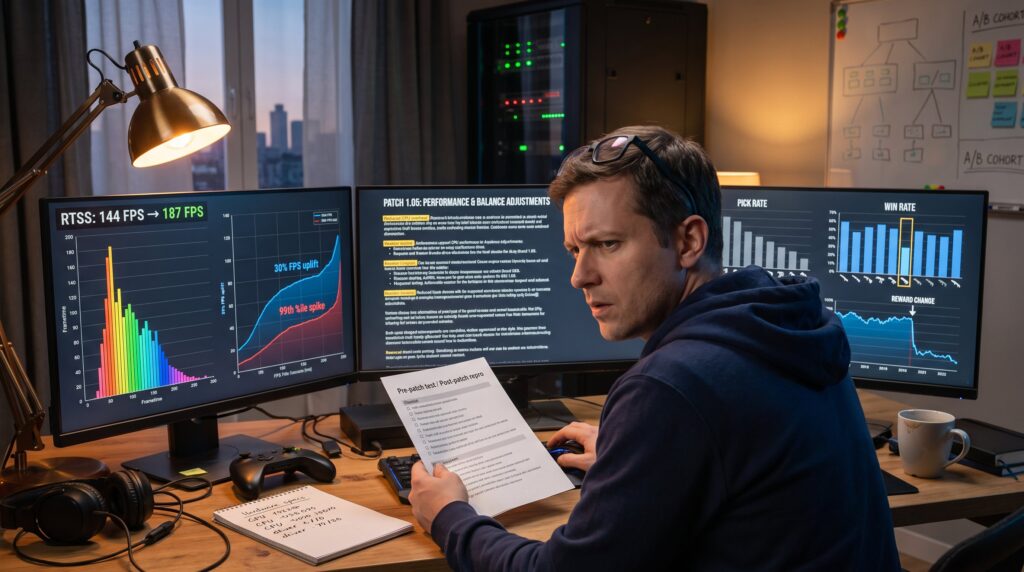
How Game Patches Can Change Performance and Balance matters because a single update can raise FPS by 30% or break a favourite weapon overnight. In live games, patches alter code paths, assets, and design numbers: they fix crashes, shift the competitive meta, and change virtual economies. This guide explains why patches matter, how they change technical performance and game balance, and what players and developers can do to measure and respond. It aims to give practical steps, real examples, and honest warnings for anyone who cares about playability and fairness.
Key Takeaways
- Game patches significantly impact game performance and balance by altering code, assets, and gameplay mechanics, making them crucial for playability and fairness.
- Patches can improve FPS by optimizing rendering or CPU tasks, but may also cause regressions; measuring baseline metrics before and after updates helps detect these changes.
- Design tweaks in patches, even minor ones, can rapidly shift the competitive meta by affecting weapon strength, system behaviors, or in-game economies.
- Players should systematically log performance data and reproduce issues to assist developers, who should use A/B testing and staged rollouts to manage patch risks effectively.
- Clear, transparent communication in patch notes, separating performance fixes and balance changes, builds trust and helps the community understand updates.
- Treating patches as measurable experiments enables continuous performance improvements and balanced gameplay, benefiting both players and developers.
Why Game Patches Matter For Live Titles
Fact: Patches directly determine whether a live game stays playable and fair. Live titles run on millions of device and OS combinations: publishers push patches to fix crashes, close exploits, rebalance systems, and add content that keeps players engaged. The immediate consequence is measurable: telemetry often shows session length and concurrent players move within 24–72 hours after a major patch.
Patches keep games compatible with new hardware and operating systems. When a console or GPU driver updates, the game must adapt or it gains crashes, memory leaks, or stuttering. For example, some titles lost 20–30% of effective performance after engine-level incompatibilities until a hotfix arrived. Patches also respond to player behavior. Developers watch win rates, pick rates, and item prices: they push numerical tweaks when a weapon or build makes matches non-competitive. Live-service monetization reacts, too: changing drop rates or rewards shifts in-game inflation and player spending patterns within days.
Why should players care? Because the patch that promises “quality-of-life fixes” can quietly change input lag, frame pacing, or which strategies win ranked play. Why should developers care? Because poorly tested changes damage trust, reduce revenue, and create support overload. Both sides gain when teams treat patches as measurable experiments rather than magic drops.
How Patches Change Performance: Technical Causes And Real-World Examples
Answer: Patches change performance by altering rendering, CPU logic, or asset handling. Each change hits a different resource, and the result depends on hardware balance.
Rendering changes are obvious causes. Adding a new post-process effect or increasing draw calls raises GPU load. Turning on or tuning ray tracing modes can cut frame rates dramatically on older GPUs. Conversely, optimizing shaders or reducing overdraw can raise average FPS by double digits. CPU and engine changes matter when logic moves between threads or when new systems add frame-blocking work. Better threading and culling can lower frame times: added debug code, new hit‑registration logic, or synchronous IO can spike CPU use and introduce stutters.
Asset and IO updates also bite performance. Recompressing textures, changing streaming heuristics, or altering save formats affects load times and mid-session hitching. A well-known example: a patch that disabled an async compute path on certain GPUs halved FPS for a subset of players until a follow-up fix restored parallelism. Another post-patch case showed a 26% average uplift when developers realigned CPU limits via thread optimizations. Such swings show why pre/post measurements matter.
Practical measurement: players should log baseline metrics, average FPS, 1% lows, frame-time variance, input latency, before applying updates. Tools like RTSS, OCAT, or built-in frametime graphs provide the data. Developers should use A/B rollouts and telemetry buckets to detect regressions across GPU vendors, CPU families, and driver versions. When stutter appears, compare frame-time histograms, not only averages: a 5% drop in average FPS with a 300% increase in 99th percentile frame times feels worse.
External resources explain common fixes for stutter and hitching in PC games: a practical troubleshooting guide helps players isolate driver or IO issues and verify if a patch introduced a regression. unexpected slowdowns guide provides hands-on steps for PC setups and complements in-game metric checks.
How Patches Shift Game Balance: Design Choices, Meta Shifts, And Economic Effects
Insight: Balance moves when designers change numbers, systems, or rewards, sometimes intentionally, sometimes accidentally. Small numerical tweaks cause outsize meta shifts because players quickly converge on high-value choices. A 5% damage buff can flip a weapon from niche to meta when cooldowns, movement, and map geometry combine.
Design changes fall into clear classes. Numerical adjustments (damage, cooldowns, health) directly change win rates and role viability. Systemic changes, altering resource regeneration, matchmaking rules, or interaction timing, reshape play patterns and can shift average match length or kill density. Content patches add new tools: a new hero, weapon archetype, or map can destabilize established counters and force a meta re-evaluation.
Meta shifts happen fast. In ranked ecosystems, pick rates move within hours: top players broadcast new builds, and streaming amplifies adoption. Data examples show average kills per match changing by measurable margins after rebalancing patches. Developers who expect this use staged rollouts and monitor pick/ban and win-rate curves to decide follow-ups.
Economies react predictably to reward changes. Increasing drop rates for a rare item lowers scarcity and can crash player-driven markets: reducing crafting costs increases usable items in circulation and alters progression pace. Monetization effects follow: if a patch makes grind easier, microtransaction conversions often dip: if a patch introduces a desirable vanity item, conversions can spike. Honest lessons: one developer noted that a well-intentioned quality-of-life changes reduced premium currency purchases by 12% because players needed fewer shortcuts.
Practical signals to watch: pick rate, win rate by skill tier, match duration, item circulation, and player churn. Players tracking ranked ladders should compare season-over-season metrics: developers should bucket telemetry by platform and cohort. For contextual guidance on broader game topics, RevolverTech maintains a pillar resource about games, gear, and player updates that teams use as a reference when designing patch communications: gaming overview.
Practical Steps For Players And Developers To Measure, Test, And Respond To Patch Changes
Direct answer: Test with measured baselines, compare identical scenarios, and communicate exact repro steps. Both sides need systematic habits.
Players should follow this checklist before updating: record a baseline scene (start a replay, run a benchmark, or capture a repeatable multiplayer map segment) that reflects typical play. Log average FPS, 1% lows, frame-time graphs, load times, and input lag values. After patching, rerun the same sequence with identical settings and drivers. If a regression appears, gather hardware specs, driver versions, and saved logs, then file a concise report that reproduces the issue. Community forums and structured bug forms help prioritize fixes.
Developers should adopt an experiment-first mindset. Use A/B tests, staged rollouts, and telemetry buckets so that only a subset of players receive risky changes initially. Track crash rate, frame-time variance, matchmaking wait times, and economy flow metrics. Instrument decisive signals: win-rate per hero/weapon by skill percentile, average session length, churn within 7 days, and item acquisition rates. Keep performance budgets: set target percentiles for frame-time and budget CPU/GPU costs for new features.
When a regression is detected, respond quickly with a hotfix or rollback. Communicate clearly: patch notes must separate performance fixes, balance changes, and content additions so players and media can parse changes without guessing. A minority of teams make the mistake of bundling unrelated fixes: one studio learned this the hard way after a balance tweak and an unrelated IO change caused regressions that were hard to triage together.
For teams building robust processes, cross-functional preflight checks, QA reproduction, developer instrumentation, and a short public test window, reduce risk. Players who document reproducible cases help developers pinpoint regressions faster, shortening hotfix cycles and restoring trust.
Conclusion
Takeaway: Game patches are powerful levers that can improve or worsen performance and reshape balance and economies. Measurable testing, clear telemetry, and honest player communication reduce risk. Both players and developers benefit when changes are treated as experiments: baseline metrics, staged rollouts, and transparent notes make patches a tool for steady improvement rather than surprise disruption.